How often should a diesel fuel filter be replaced?
Replace a diesel fuel filter at the interval specified for the exact engine and filter position, using hours, mileage, calendar time, or a service indicator as the manufacturer directs. Investigate restriction, water warnings, or suspected contaminated fuel immediately, even before the scheduled change. There is no single interval that safely covers every truck, tractor, and excavator.
A filter change schedule should answer two questions: when is planned service due, and what condition requires attention sooner? Confusing these questions leads to unnecessary replacements on some machines and delayed maintenance on others. The right starting point is the operator or engine manual, supported by service records and fuel-quality observations.
This guide explains how to build that schedule without treating a generic mileage figure as a specification. It covers diesel fuel filtration, not diesel particulate filter regeneration or engine oil filter service.
Why engine hours, mileage, and calendar time are different
Engine hours measure operating time, including work that adds little or no road distance. A tractor can spend an entire shift driving a stationary implement. An excavator can load trucks all day while moving only a short distance. A truck may accumulate substantial idle time between deliveries. Mileage alone misses those operating conditions.
Calendar time captures a different exposure: the passage of time while equipment and fuel remain in storage. A machine with low hours can still have water ingress, degraded stored fuel, or an overdue time-based service requirement. Low utilization is not evidence that fuel has stayed clean.
Do not convert a road-truck mileage interval into an excavator hour interval using an assumed average speed. The engines may use different filtration arrangements, fuel consumption rates, water separators, and service criteria. Even two machines with the same engine family can have different installations.
If the manual lists more than one service trigger, preserve the exact rule. Where it specifies “whichever occurs first,” do not wait until every limit is reached. Where an approved indicator controls a particular service action, use the manufacturer's indicator instructions rather than inventing an additional limit.
Find the correct maintenance schedule before choosing an interval
Start with the machine model and serial number. Then record the engine model and serial number, since replacement engines or production changes can make the machine name alone insufficient. Identify the primary filter, secondary filter, and water separator separately.
Look for the normal-service schedule, severe-service notes, fuel requirements, and the procedure for the installed filter assembly. A draining instruction is not necessarily a filter replacement instruction. A primary separator and a secondary fine filter may also have different inspection or replacement requirements.
Confirm these details before ordering:
- The applicable manual revision and serial-number range.
- Whether the schedule refers to the primary filter, secondary filter, or both.
- The stated hours, distance, time limit, or approved restriction indicator.
- Any modified schedule for severe operation or specified fuel blends.
- The correct element, seals, drain arrangement, and priming procedure.
If the service history is unknown, consult the applicable manual or service provider about establishing a baseline. Photograph the installed components and inspect the fuel supply before assuming a new filter alone will restore a neglected system.
For replacement selection, start with engine spare parts and verify the application against the original equipment manufacturer (OEM) part number. Physical resemblance is not enough to establish compatibility.
Diesel fuel filter interval matrix by operating condition
The following matrix is a scheduling guide, not a table of manufacturer-approved replacement hours. Enter the actual limits from your manual into the maintenance record.
| Application or condition | Schedule to use | What to check between scheduled services | What changes the decision |
|---|---|---|---|
| Highway diesel truck | Applicable engine or vehicle schedule, including its mileage, hour, and time rules | Fuel warnings, separator condition, performance under load, service history | Verified restriction, contaminated refill, or a severe-service classification |
| Tractor doing sustained field or PTO work | Model-specific hour and calendar requirements | Refueling practices, separator condition, tank contamination, operating symptoms | Repeated restriction, water ingress, or fuel-quality concerns |
| Excavator using mobile site refueling | Machine and engine manual requirements | Transfer equipment cleanliness, caps, water warnings, fuel supply under working load | Evidence of contamination or abnormal supply restriction |
| Low-hour or seasonal equipment | Calendar limit as well as the operating-hour requirement | Stored fuel, water accumulation, leaks, startup condition | Water or degraded fuel may require investigation before returning to work |
| Cold-weather operation | Normal schedule plus approved winter operating instructions | Fuel grade, temperature-related symptoms, water and ice risks | Wax or ice restriction requires attention to fuel condition, not only filter age |
| Frequent premature plugging | Investigate the cause while following the service schedule | Tank, delivered fuel, transfer system, removed element, pressure observations | Repeated failure is a fuel-system problem until the cause is identified |
Donaldson's fuel filter plugging guidance describes low-power events, unexpected shutdowns, and rapid plugging as reasons to examine fuel quality. It also explains that short filter life can involve fine precipitates and fuel chemistry, not simply visible dirt. That is why this matrix does not assign the same shortened interval to every dusty worksite.
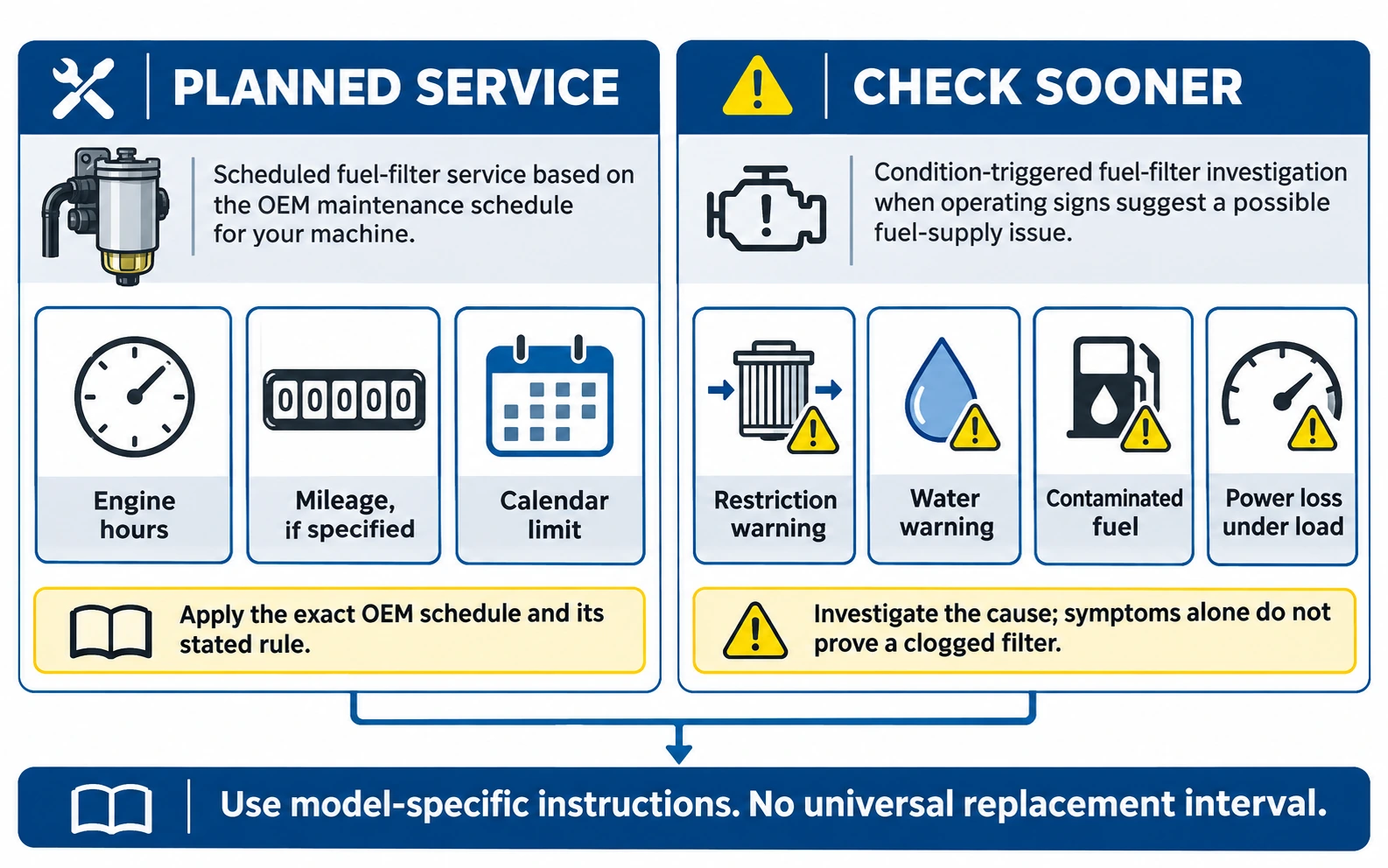
Use the machine manual for the actual service limits and inspection procedure.
Which operating conditions can shorten useful filter life?
Contamination during storage and transfer
Fuel passes through several opportunities for contamination before reaching the engine: delivery, bulk storage, mobile tanks, hoses, dispensing nozzles, and the machine's own tank. A clean new element cannot prevent contamination already entering upstream.
Inspect damaged filler caps, open transfer connections, poorly maintained breathers, and water entry points. Keep dispensing equipment clean and use an appropriate fuel-management process. Dusty surroundings matter most when dirt can actually enter the fuel system. An air filter's dust loading does not automatically establish the fuel filter's replacement interval.
Donaldson's clean diesel best practices recommend monitoring stored fuel, removing water, maintaining tanks, and filtering fuel during appropriate handling stages. These measures address the source of repeated filter loading.
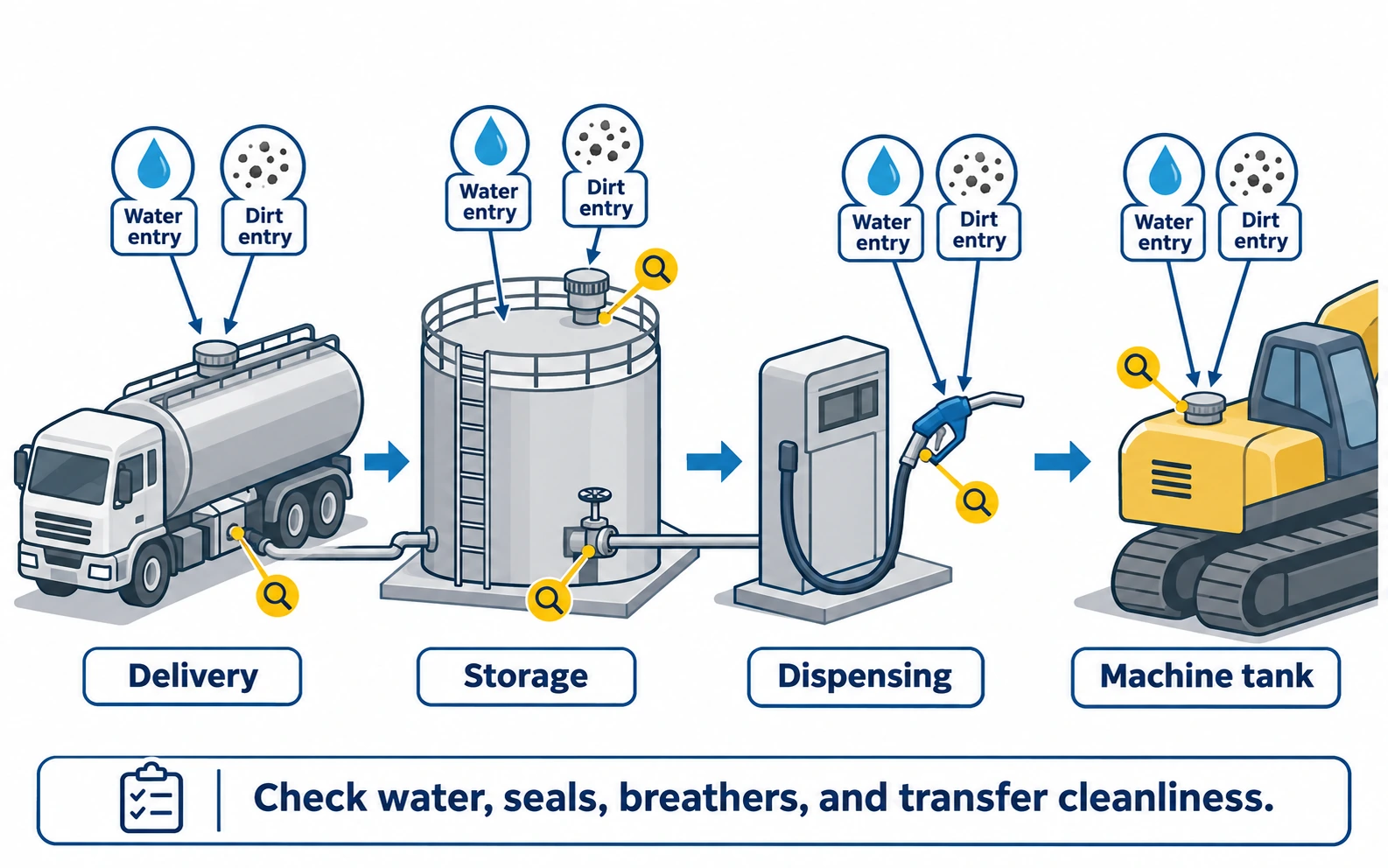
Illustrative fuel-handling checkpoints, not an engine-specific plumbing diagram.
Water contamination
Water may enter through leaks, condensation, handling, or fuel deliveries. Free water can contribute to corrosion and microbial growth, while cold conditions can turn it into ice. A water separator helps manage specific forms of water, but it does not prove that every form of contamination has been removed.
Follow the manual's inspection and draining instructions. If water repeatedly returns, investigate the tank and supply chain. Simply draining the bowl every time without addressing the source can leave the engine exposed to an ongoing problem. Donaldson explains these mechanisms in Water is the Hidden Enemy of Diesel Engines.
Cold weather and fuel composition
A filter may restrict soon after installation if cold fuel produces waxy solids or if free water freezes. In that situation, elapsed hours are not the main explanation. Note whether symptoms started after an overnight temperature drop or a change in fuel supply.
Use the engine manufacturer's approved winter fuel strategy and consult the fuel supplier. Do not add gasoline, use open flames, or substitute a less efficient filter to force fuel through. Donaldson's cold-weather guidance describes how wax and ice can block filtration. The appropriate response depends on the fuel and equipment, not a universal ambient-temperature threshold.
Warning signs that need attention before the scheduled interval
Possible restriction symptoms include reduced power under load, hesitation, difficult starting, or stalling. These symptoms are not proof of a clogged element. Air entering the low-pressure side, a blocked pickup, a supply-pump problem, or an unrelated engine fault may produce similar behavior.
A water-in-fuel warning is also different from a restriction warning. It calls for the manufacturer's specified response to water detection and, where needed, sensor diagnosis. It does not measure the filter's remaining dirt-holding capacity.
Stop operation when the manual requires it, when fuel leakage creates a hazard, or when the engine cannot operate safely. Avoid repeatedly running a machine under heavy load just to see whether the symptom disappears. Use tests for clogged diesel fuel filter symptoms to organize the next diagnostic steps.
Useful observations include when the symptom occurs, fuel level, ambient temperature, recent refueling, active fault codes, and whether the problem began immediately after maintenance. This information is often more valuable than guessing from the outside appearance of the filter canister.
How to calculate the next service point
Use the limits printed in the applicable manual, then record the installation date, hour reading, and odometer reading where relevant. Keep the original units so that conversions do not introduce errors.
Here is an arithmetic example only, not a recommendation for any model. Suppose a verified schedule required replacement every 500 operating hours or 12 months, whichever came first. If the filter were installed at 2,140 hours on March 10, the next limits would be 2,640 hours and March 10 the following year. The earlier limit would control.
A condition that demands immediate service would still override that planned date. Conversely, a machine that seems to run well should not automatically receive an extension beyond its prescribed schedule.
For a mixed fleet, maintain separate records by machine and filter position. A practical service log includes:
- Machine identification, engine identification, and filter location.
- Installed part number and replacement seal details.
- Date, engine hours, and mileage where applicable.
- Manual-based next service limits.
- Water findings, restriction measurements, and relevant operating conditions.
- Technician notes about priming, leaks, and post-service performance.
An operator can then report a developing issue without having to reconstruct the last service from a purchase invoice.
Replacement quality matters as much as timing
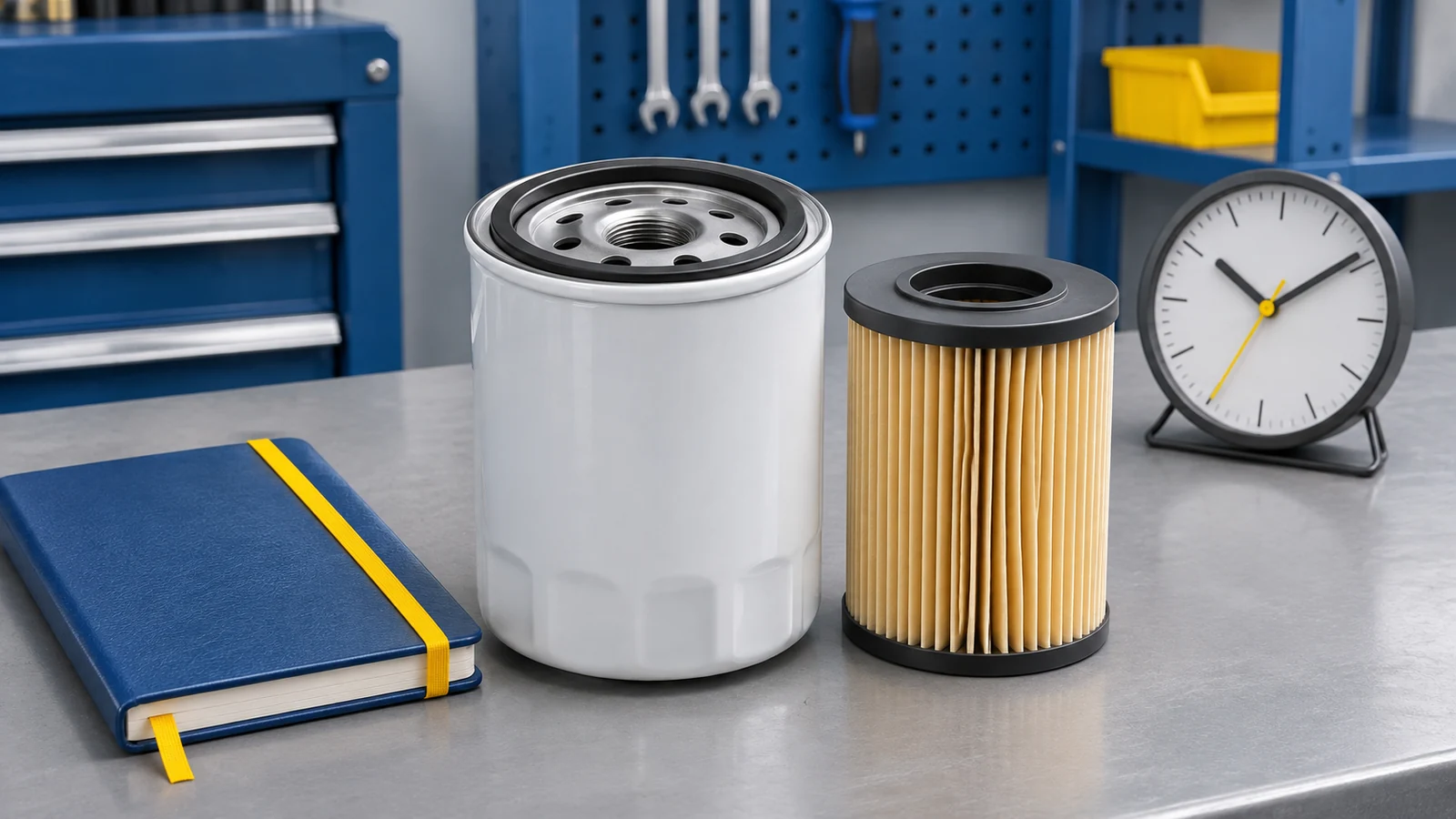
Choose a filter that matches the specified application, filtration performance, flow requirements, and water-separation function. A matching thread or similar canister size does not confirm that the element provides the required protection. Check sensor connections, bowl compatibility, seals, and installation orientation as well.
Browse seals, filters and maintenance parts when preparing the service kit, but confirm the exact component before purchase. The cheapest filter is not economical if it introduces leakage, incorrect fitment, or inadequate filtration.
Keep dirt away from open fuel connections. Follow the manufacturer's instructions on whether the element must be installed dry or filled in a specified way. Do not pour unfiltered fuel into a clean-side opening. Use the approved priming method and observe starter duty-cycle limits.
Modern common-rail systems can retain dangerous pressure. Never loosen high-pressure injector lines to bleed air unless a qualified technician is following the exact approved procedure. Routine filter service should not become improvised high-pressure fuel-system work.
After installation, check for leakage by an approved safe method and confirm proper operation. Record the work only after the service is complete, not when the replacement part is ordered.
What repeated early filter changes are telling you
If an element reaches its service limit unusually early, retain the maintenance facts before changing the schedule. Compare the affected machine with others using the same fuel source. Did the issue begin after a delivery, a transfer-tank change, a cold spell, or an extended storage period?
A pattern across several machines points toward a shared fuel or handling issue. A problem isolated to one machine may justify checking its tank, pickup, hoses, filter housing, and installation. Neither pattern proves the cause by itself, but both narrow the investigation.
Changing filters more frequently can restore operation temporarily while leaving the source untouched. Fuel sampling, tank inspection, and professional analysis may be needed. Do not identify microbial contamination solely from the color of a removed filter, and do not add biocide without an appropriate diagnosis and approved treatment plan.
For budgeting, see diesel fuel filter replacement cost. Separate scheduled maintenance from contamination cleanup so that recurring problems remain visible.
Frequently asked questions
Is 250 or 500 hours the correct diesel fuel filter interval?
Neither number is a universal rule. Use the interval for your exact engine, installation, and filter position. An hour figure without a model, manual reference, and operating-condition context is not sufficient for a maintenance decision.
Should I replace the filter every year if the machine has low hours?
Follow the manual's calendar requirement. Low hours do not cancel a time limit, and stored fuel can develop water or contamination problems. If no calendar interval is stated, ask the manufacturer or service provider rather than creating one from an unrelated machine.
Does draining the water separator replace a filter change?
No. Draining removes collected liquid as specified by the assembly's instructions. It does not renew the filter media or reset its service life. Inspection, draining, and element replacement are separate maintenance actions.
Can I extend the interval because the engine still runs normally?
Normal operation alone is not evidence that an extension is safe. Follow the prescribed schedule unless an applicable manufacturer-approved maintenance program provides another basis. Keep documented measurements and fuel-quality information if an approved program requires them.
What should I send when requesting a replacement filter?
Send the OEM part number, machine model, machine serial number, engine identification, and photographs of the installed filter and connections. Identify whether you need the primary separator, secondary filter, or a complete service kit.
Plan the service and confirm the part
The most reliable fuel filter replacement intervals combine the correct manual schedule with attention to abnormal conditions. Track hours and calendar limits, maintain the fuel supply, and investigate warning signs before assuming the filter is the only problem.
Request a filter and fitment quote with your OEM part number, machine model, and serial number. Include the filter position and any bowl or sensor details so the requested parts match the actual installation.