What are the symptoms of a clogged diesel fuel filter?
A clogged diesel fuel filter can cause loss of power under load, hesitation, difficult starting, stalling, or a fuel-supply warning. These symptoms also occur with air leaks, pickup restrictions, supply-pump faults, and other engine problems. Confirm the cause with the manufacturer's low-pressure fuel-system checks before condemning the filter, pump, or injectors.
The most useful clue is often when the symptom appears. An engine that idles normally but loses power while towing, digging, or running a PTO implement may have a fuel-delivery problem that only becomes apparent at higher demand. That pattern narrows the investigation, but it does not identify the failed component.
This guide is for diesel trucks, tractors, and construction equipment. It distinguishes observations an operator can record from measurements that require the correct service information, test equipment, and training.
Start with safety and the correct fuel-system layout
Park the machine safely, secure it against movement, lower attachments as instructed, and follow the applicable shutdown and isolation procedure. Work in a ventilated area away from ignition sources. Use appropriate eye protection, gloves, spill containment, and approved fuel containers.
Do not loosen common-rail pipes or injector connections to check whether fuel is present. High-pressure fuel can penetrate skin, and pressure may remain after shutdown. Suspected injection injuries require immediate emergency medical care. Never search for a fuel leak with your hand.
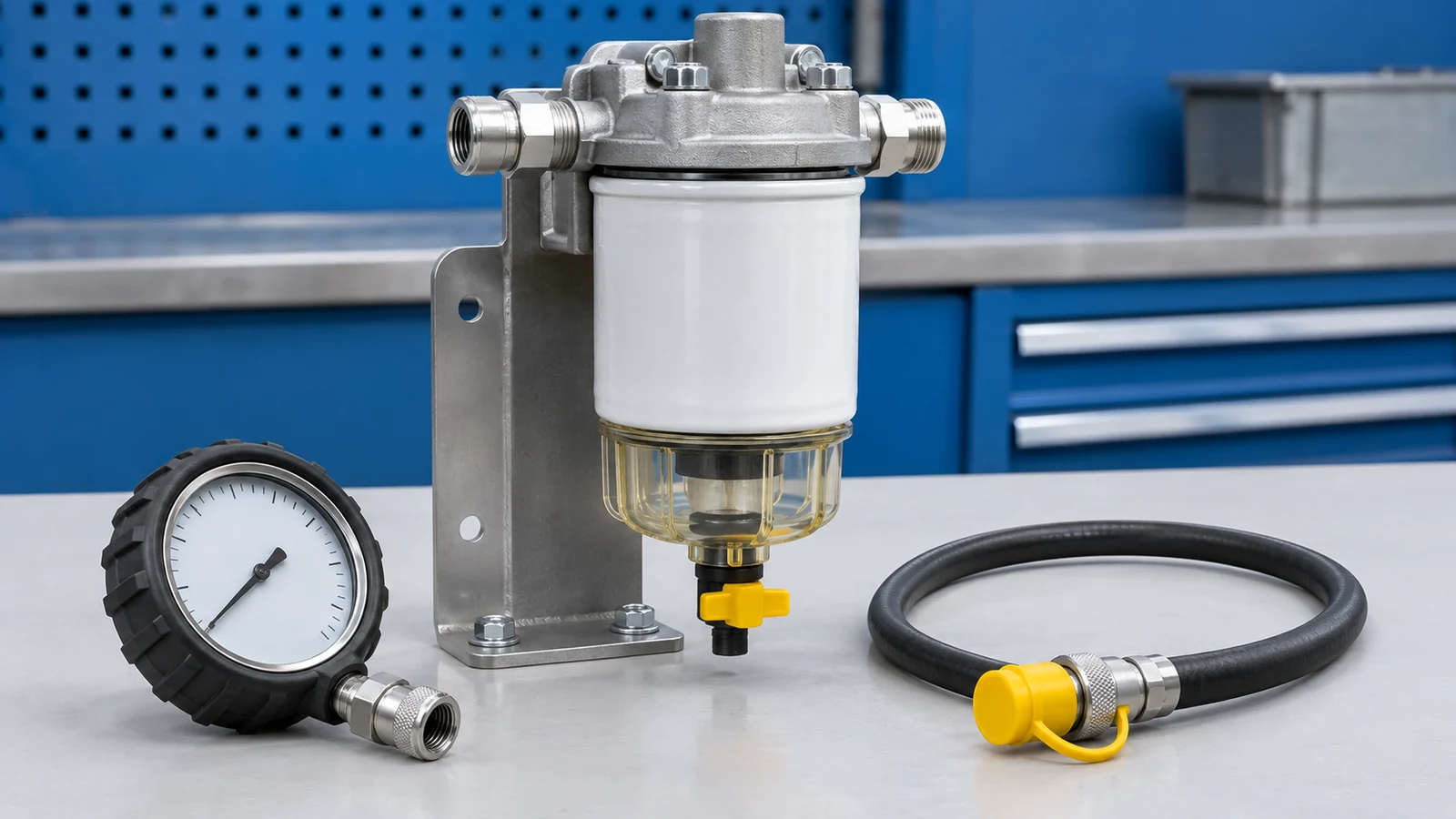
Identify the circuit before taking measurements. A typical installation may include a tank, pickup, primary filter or water separator, transfer pump, secondary filter, high-pressure pump, and injectors. The actual order varies. Some primary filters operate under suction; others are on a pressurized supply circuit.
That difference matters because a pressure reading has meaning only when you know where it was taken. A low-pressure supply test and a common-rail pressure reading answer different questions. Neither should be interpreted using a specification from a different engine.
Match the symptom to the operating condition
| Observed symptom | Why a restricted filter is possible | Other causes to investigate | Useful next evidence |
|---|---|---|---|
| Normal idle, weak performance under load | The fuel path may not support higher demand | Tank pickup, supply pump, intake or boost fault, commanded derate | Approved supply-pressure or restriction test under the specified condition |
| Long cranking after filter service | Incorrect installation may restrict flow or allow air entry | Lost prime, seal problem, wrong element, unrelated starting fault | Installation check and approved priming procedure |
| Engine starts, then stalls | Available fuel supply may become insufficient | Blocked tank vent, air ingress, electrical supply fault | Symptom timing, fuel level, codes, low-pressure circuit checks |
| Water-in-fuel warning | The separator may contain collected water | Sensor or wiring fault | Manufacturer-directed draining, inspection, and sensor diagnosis |
| Problem occurs only in cold weather | Wax or ice may restrict the fuel path | Battery, starting system, fuel-heater fault | Fuel specification, temperature history, water checks |
| New filter restricts again quickly | Contamination may still be arriving upstream | Incorrect element or unresolved system fault | Tank and fuel-source investigation, retained sample, filter inspection |
Donaldson lists low-power events, shutdowns, and rapid filter plugging among warning signs of fuel-quality trouble in its fuel filter plugging article. The key diagnostic lesson is that a filter can reveal an upstream problem rather than be the original source of it.
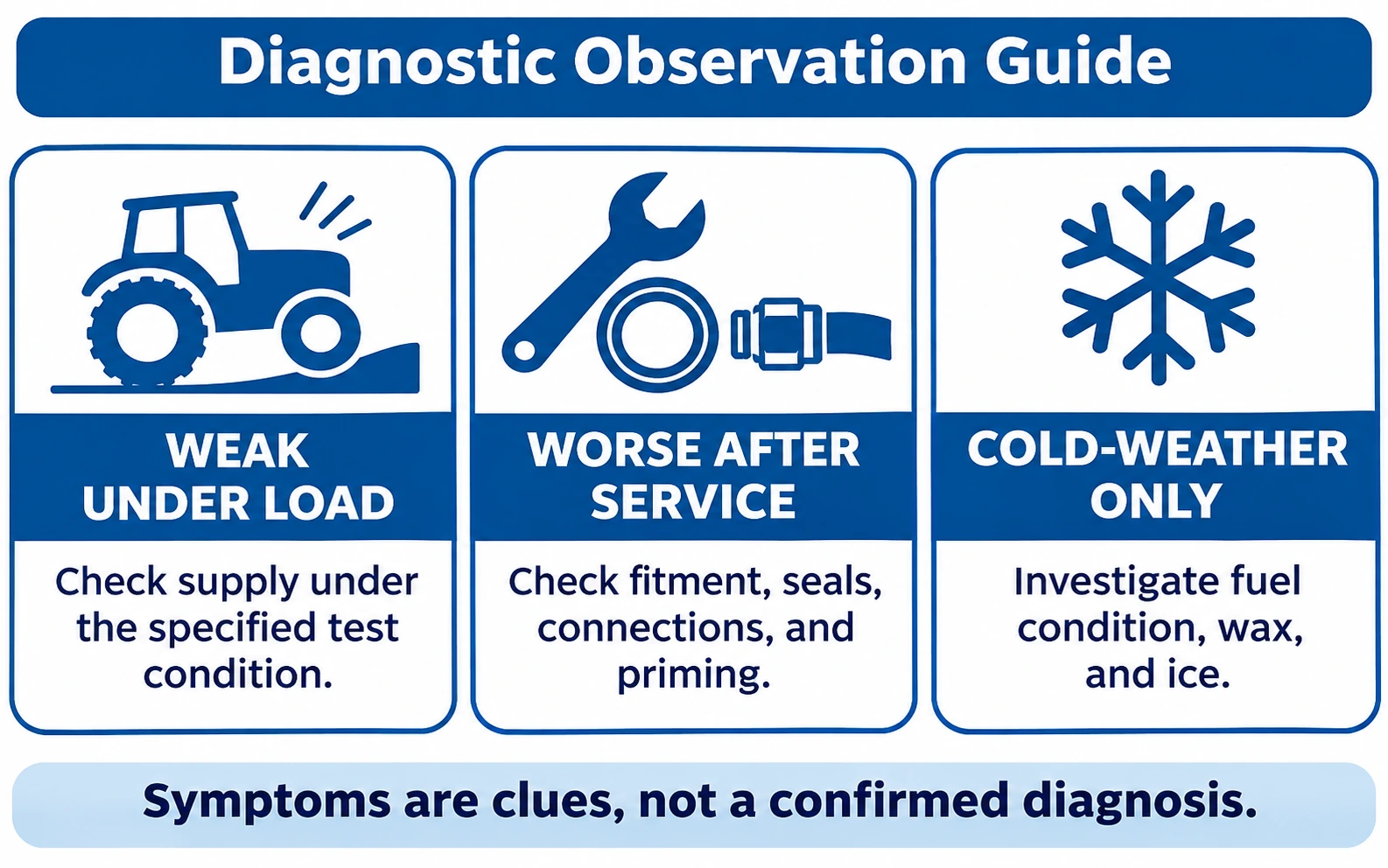
Operating patterns guide the next test but do not prove the filter has failed.
Test 1: Record the complaint before changing anything
Write down the machine identification, engine identification, engine hours, fuel level, and recent service history. Ask when the fault began and whether it followed a refill, cold night, filter replacement, or long storage period.
Record the operating condition accurately. “Loses power after twenty minutes while climbing” is more useful than “runs badly.” For an excavator, distinguish a problem during hydraulic work from one that occurs at idle. For a tractor, note whether PTO load, travel load, or both bring on the symptom.
Read and save available diagnostic trouble codes and freeze-frame information before clearing them. A code describing low rail pressure does not prove that the rail-pressure sensor, high-pressure pump, or filter is defective. It is evidence of a condition that must be interpreted through the manufacturer's diagnostic procedure.
Avoid repeated test runs if the machine stalls unpredictably or could place people at risk. A controlled workshop test may be needed instead of reproducing the fault on a road, slope, or active jobsite.
Test 2: Inspect the low-pressure supply path
With the equipment shut down and made safe, inspect accessible fuel hoses, filter housings, drains, electrical connections, and the area around the service components. Look for damage, loose connections, incorrect routing, and evidence of leakage.
On a suction-side circuit, air may enter a connection without producing an obvious outward fuel leak. A recently disturbed seal, drain, bowl, or hose connection therefore deserves attention even if the assembly looks dry. Do not tighten plastic components indiscriminately; use the specified installation method and torque.
Confirm the installed filter part number and position. Two visually similar filters can have different functions or requirements. Check for an old seal left in place, a missing seal, or a sensor connection that was not restored after service.
Check tank venting and the pickup according to the service manual. Do not operate with a loose cap as an improvised workaround. If the tank contains contamination or the supply line is restricted upstream, a replacement filter may not resolve the complaint.
Use the OEM part-number verification guide before ordering from the engine spare parts category.
Test 3: Check water separation and fuel condition
A separator bowl, where fitted and inspectable, can provide useful evidence. Follow the assembly's procedure for checking or draining it. Never assume that opening any drain is safe while the system is operating or pressurized.
Collect a sample only from an approved sampling point, using a clean, suitable container. Record the sample location, date, recent fuel delivery, and machine identity. Visible sediment, separate liquid layers, or unusual material justify further investigation, but appearance alone cannot measure fuel cleanliness or identify every contaminant.
Donaldson's water contamination guidance distinguishes dissolved, free, and emulsified water. Not all water is visible as a layer at the bottom of a container. A clear sample therefore does not prove that fuel is within the engine manufacturer's requirements.
A recurring water warning should lead to checks of the tank, filler, storage system, and supply chain, along with the sensor circuit when indicated. Do not simply disconnect the sensor or assume the filter element is clogged.
If several machines develop symptoms after the same fuel delivery, retain relevant delivery information and seek qualified sampling or laboratory advice. This can prevent repeated replacement of otherwise correctly selected components.
Test 4: Measure restriction or pressure drop correctly
The decisive test is not a universal pressure number. It is a measurement made at the specified test points, under the specified operating conditions, compared with the limit for that engine and installation.
A filter pressure-drop measurement compares pressure upstream and downstream of the element. In simple terms:
Filter pressure drop = upstream pressure minus downstream pressure.
For illustration only, readings of 8 psi before a filter and 5 psi after it give a 3 psi difference. That arithmetic does not establish whether 3 psi is acceptable. The service manual must supply the relevant test conditions and limit.
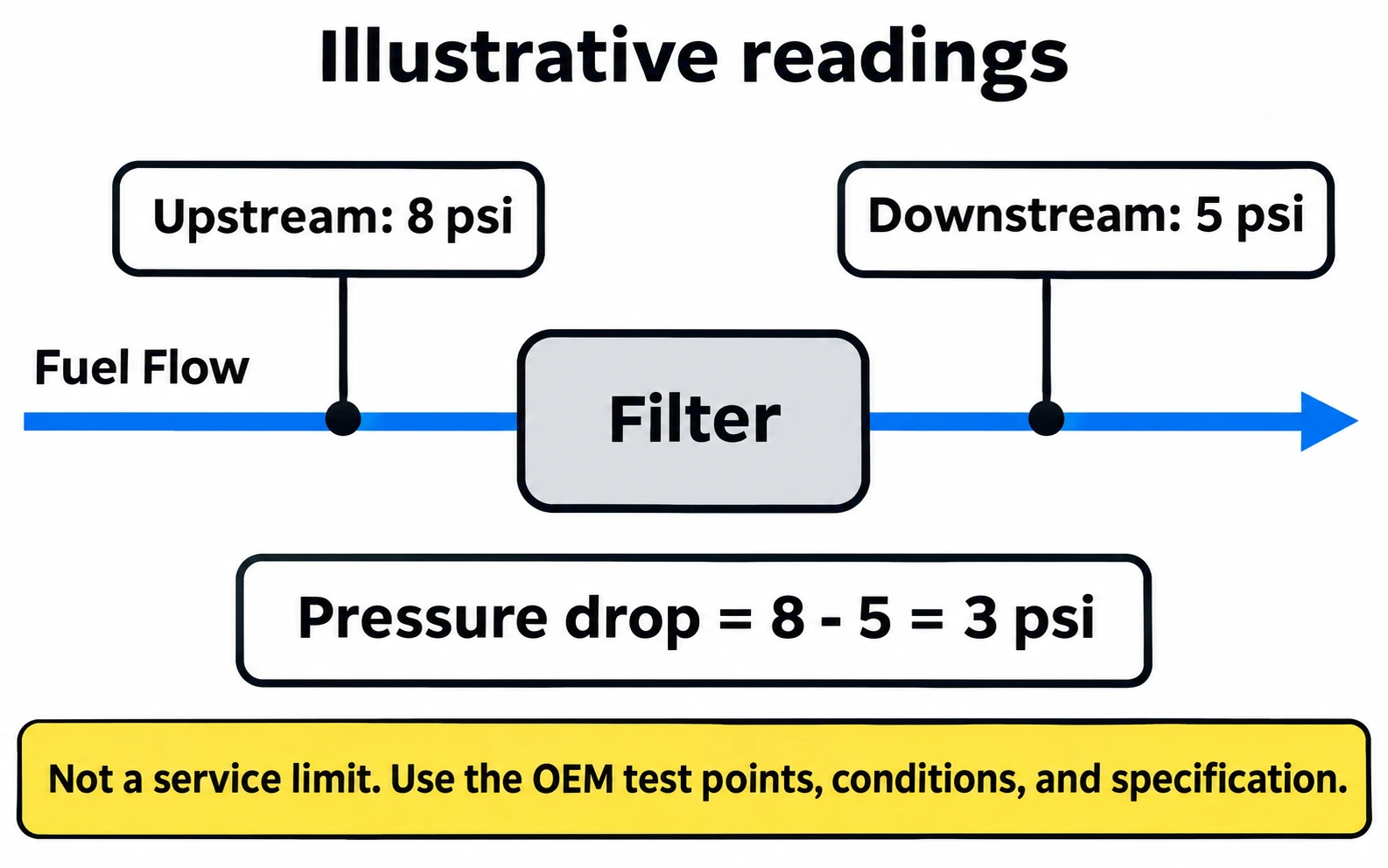
The 3 psi result is an arithmetic example, not a universal service limit.
A single vacuum or restriction gauge at a pump inlet may reflect the entire upstream path, including the pickup, hoses, fittings, and filter. It does not automatically isolate the filter. Where approved upstream and downstream test points are available, their relationship can help locate the restriction.
Flow and fuel temperature affect the reading. A measurement at idle may not reproduce a fault that occurs only under working load, and cold fuel may behave differently from warm fuel. Use the manufacturer's test condition rather than choosing an arbitrary engine speed or load.
A qualified technician should use compatible, correctly rated instruments and clean adapters. Follow safe installation, depressurization, and leak-check procedures. If the system does not provide an approved test arrangement, do not drill the housing or improvise connections.
Test 5: Separate supply-pump problems from filter restriction
If measurements show an abnormal pressure drop across the filter under the correct conditions, filter restriction becomes a stronger explanation. If supply pressure is low without an abnormal drop across the element, investigate the remaining circuit rather than repeatedly replacing filters.
Possible causes include an upstream obstruction, air ingress, a supply-pump problem, or inadequate electrical supply to an electric pump. The correct next test depends on the system design. A pump that can be heard running is not necessarily producing the required flow or pressure.
On electronically controlled systems, commanded and actual rail pressure can help a trained technician understand the complaint, but rail-pressure data alone does not localize a low-pressure supply fault. Check the supply system using the engine maker's diagnostic sequence before assuming an expensive high-pressure component has failed.
Do not bypass the filter to see whether the engine improves. Unfiltered fuel can expose the injection system to contamination, and an apparent improvement would not justify that risk. An approved diagnostic process can compare the relevant measurements without sacrificing filtration.
Test 6: Consider cold-weather restriction
A nearly new filter can become restricted by wax or ice. If symptoms appear only after temperatures fall, document the fuel grade, recent fuel purchases, storage conditions, and any approved cold-weather equipment fitted to the machine.
Donaldson's cold-weather technical article explains that free water can freeze and fuel hydrocarbons can form solids that block filters. Replacing the element without correcting the fuel condition may provide only temporary relief.
Follow the manufacturer's safe warming and fuel-handling instructions. Do not use an open flame, add gasoline, or select a coarser element without explicit application approval. Cold-flow additives also need to be suitable for the fuel and used according to approved instructions; they are not a universal cure for an already restricted system.
A symptom that improves when the weather warms is useful evidence, not a complete diagnosis. Battery condition, starting aids, sensors, and other systems can also be temperature-sensitive.
When replacement is justified
Replace the element when the prescribed service interval has arrived, when the approved tests establish restriction, when the element is damaged, or when the applicable contamination procedure calls for replacement. Do not attempt to wash and reuse disposable media unless the manufacturer explicitly identifies the component as serviceable that way.
Use the correct filter and replacement seals. Keep clean-side connections protected, install the element as instructed, and follow the approved priming procedure. Do not assume that prefilling is allowed on every engine.
The seals, filters and maintenance parts category is a starting point for sourcing the service items. Confirm the exact element, bowl arrangement, drain, and water-sensor compatibility before installation.
After service, repeat the relevant checks under safe, comparable conditions. Confirm that leaks, starting behavior, warnings, and the original complaint have been addressed. A new filter that improves the symptom is useful evidence, but it does not explain why the old one became restricted.
If the problem returns quickly, preserve the removed filter and sampling information for professional inspection when practical. Repeated changes without investigating the tank or fuel source can hide the actual maintenance problem.
What to tell the workshop or parts supplier
A short evidence-based handover reduces guessing. Provide the machine model and serial number, engine details, installed filter numbers, and recent maintenance. Describe the symptom by load, temperature, duration, and fuel level.
Include fault codes and test results with their units, test locations, and operating conditions. A note saying “fuel pressure low” is much less useful than a properly documented reading compared with the correct specification.
State whether water was found and whether other machines share the same fuel source. Photographs of the filter assembly and its connections can help identify parts, but they do not replace measurements.
Use the companion guides on replacement intervals and replacement cost to separate the maintenance schedule from the diagnostic job.
Frequently asked questions
Can a clogged diesel fuel filter cause power loss only under load?
Yes. A restricted supply may be sufficient at idle but inadequate at higher fuel demand. However, intake, boost, electronic derate, pickup, and pump problems can produce a similar complaint. Confirm the cause with the specified tests.
Does a low fuel-pressure code prove the filter is blocked?
No. A fault code describes a detected condition, not necessarily its cause. Check the code definition and diagnostic sequence for that engine. Filter restriction is one possibility among several fuel-supply or control-system faults.
Is a water-in-fuel light the same as a clogged-filter warning?
No. A water warning concerns water detection or the associated sensor circuit. A restriction warning concerns fuel-flow resistance where that function is fitted. Follow the manual's response to the specific warning.
Can I clean a clogged diesel fuel filter?
Replace a disposable element rather than washing or blowing it out. Cleaning can damage the media or introduce contamination. Only clean a component when its manufacturer provides a specific reusable-component service procedure.
Why does the engine run worse immediately after a filter change?
Check part compatibility, sealing, connections, and the approved priming process first. Air entry or an installation problem may have been introduced. Do not repeatedly crank beyond the starter's limits or open common-rail lines to bleed the system.
Confirm the fault, then order the correct part
Clogged diesel fuel filter symptoms are a reason to test the supply system, not a reason to replace every component connected to it. Start with the operating conditions, inspect the low-pressure circuit, and compare proper measurements with the correct manual.
Request a parts quote with your OEM part number, machine model, and serial number. Include the diagnosed filter position and assembly photos so the quotation addresses the part you actually need.